


India took out 14.3 crore new loans in the 2025 festive quarter. ₹25.3 lakh crore was sanctioned in about 90 days. That half of the story gets written every year.
This piece is about the other half: loan collections post festive season.
Every festive loan comes with a repayment schedule, and that schedule runs for months, sometimes years, after the lights come down.
2026 makes that half harder. Diwali was on 8 November, 19 days later than last year. On 7 October, the RBI raised the repo rate for the first time since February 2023. And the new RBI loan recovery rules take effect on 1 January 2027, right when this year's festive borrowers start meeting their first EMIs.
Let’s take a view of where last season's money went, who borrowed it, what happened to repayments, and what lenders can do before the first EMI is due.
Festive Season Lending in India: Where the ₹25.3 Lakh Crore Went
Lenders sanctioned ₹25.3 lakh crore across 14.3 crore new loans in the October–December 2025 quarter. Those loans landed in a retail book of about ₹90 lakh crore, and that book is mostly secured.
Secured vs unsecured: the 78:22 split
Secured credit makes up 78% of India's retail book; unsecured makes up 22%. Home loans dominate the secured side, and personal loans dominate the unsecured side.
The surprise is gold. During the 2025 festive quarter, gold became India's second-largest retail product, edging past personal loans.
Gold, two-wheelers and personal loans: the products that carried the season
Every product told a different festive story.
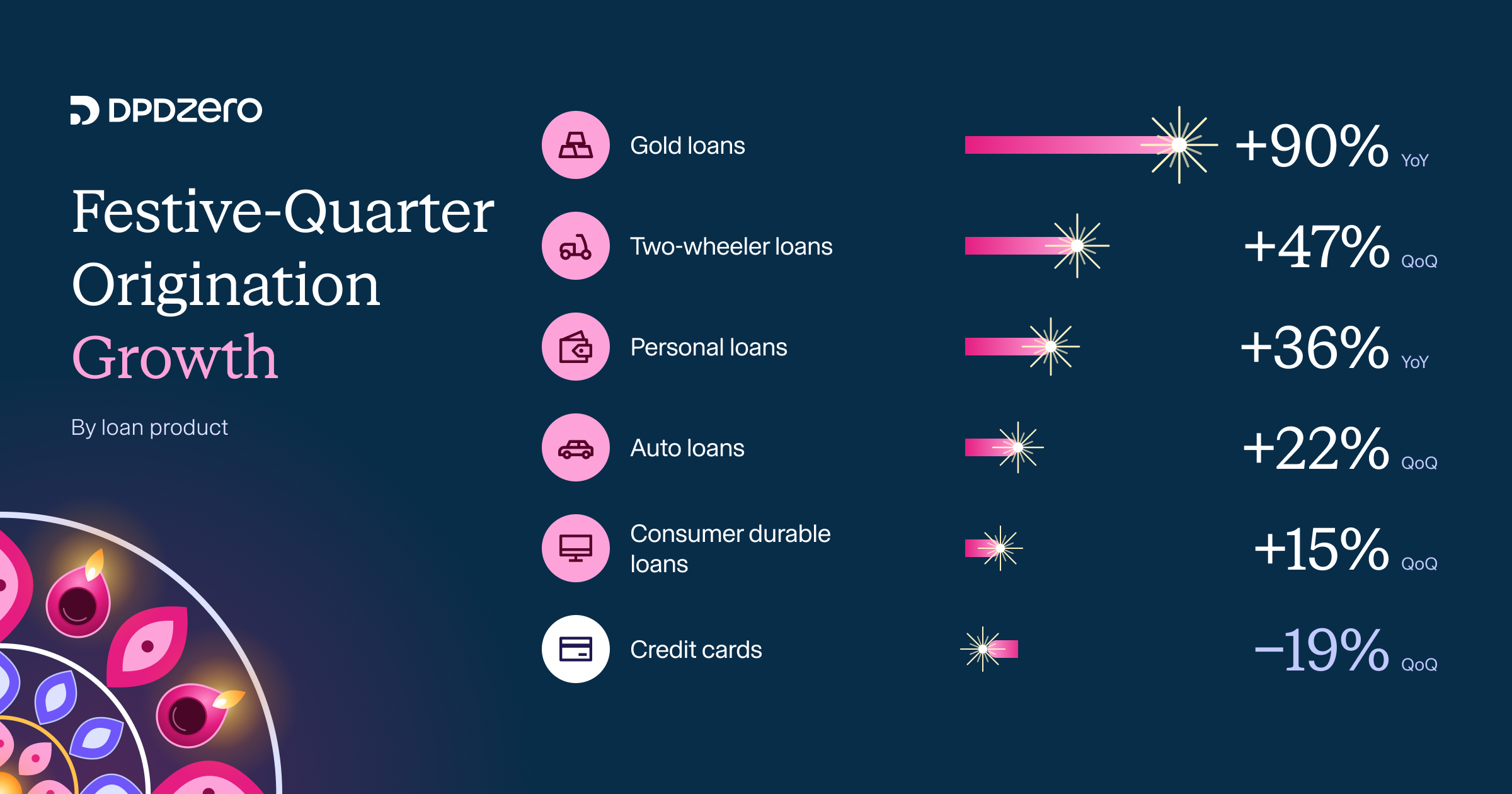
Strip out gold entirely, and festive originations were still up 26% YoY. This wasn't one product's boom. It was broad, and so is the repayment risk that follows it.
Where BNPL fits
BNPL is missing from the split above on purpose. No credit bureau publishes a BNPL figure, and private estimates vary widely. What we can observe: pay-later sits at the same checkout as consumer durable EMIs, and its repayments come due in the same January as everything else.
The quarter after, when originations cooled and repayments didn't show up. In the quarter right after the festival:
- Two-wheeler originations fell 26%
- Auto originations fell 14%
- Credit card issuance fell 9%
- Personal loans stayed flat
New lending slowed. The EMIs from the festive book kept arriving every month.
Who Borrowed This Festive Season: New-to-Credit Borrowers and India's Changing Borrower
Speed over interest rate
Festive borrowers weren't shopping on rates. 42% picked their favorite lender for speed of disbursal; only 25% put the interest rate first. When the sale ends at midnight, the loan that clears fastest wins.
That choice shows up again at collections time. A borrower who picked on speed often hasn't read the EMI schedule or planned for the first due date. The first time they think about the loan is the first time it asks for money.
New-to-credit borrowers
41% of festive personal loan borrowers were new to the product. In consumer durables, 16.3% of borrowers were new to credit altogether. For many of them, a phone or a fridge on EMI is their first credit line.
New-to-credit borrowers have no repayment history to read and no habit of paying on a fixed date. They aren't riskier by default. They're unknown, and unknown is hard to collect from when your strategy runs on old scorecards.
Rich or poor: who borrowed more?
By value, the better-off. RBI's December 2024 Financial Stability Report found per capita debt rising sharply for super-prime borrowers while staying flat for other risk tiers (summary).
By purpose, the picture flips. The Middle and lower-income borrowers put 48% of their loans towards consumption; rich borrowers put 31% there and most of the rest into assets like housing. Festive credit is consumption credit: phones, bikes, gold, gifts.
How Lenders Pushed Festive Credit
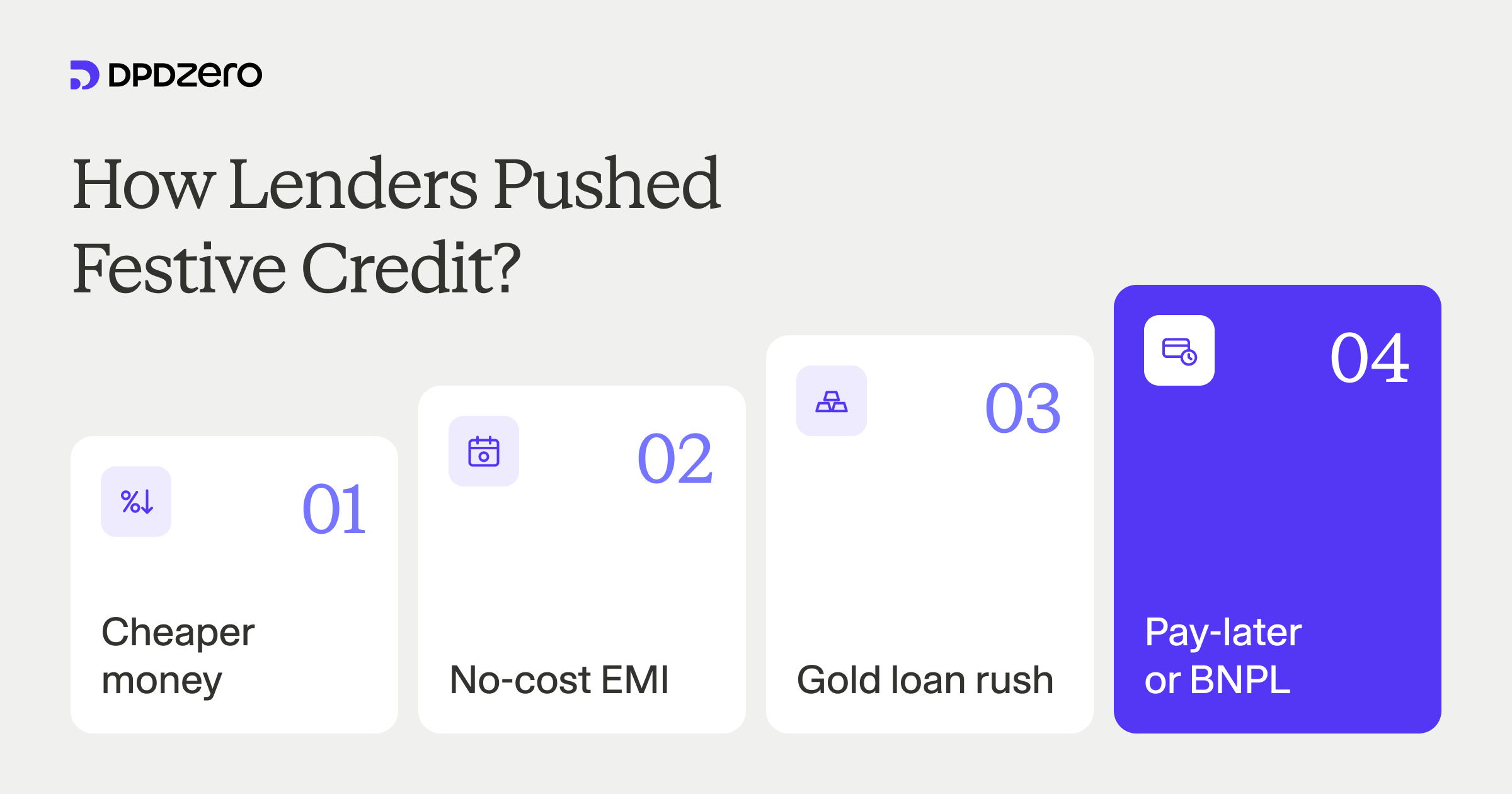
Demand didn't rise on its own. The RBI, the GST Council and lenders all pulled the same lever at once: make credit cheaper and faster.
Cheaper money: 125 bps of repo cuts and GST 2.0
Last year, between February and December 2025, the RBI cut the repo rate by 125 bps to 5.25%. Then GST 2.0 took effect on 22 September, the first day of Navratri. Small cars, two-wheelers and many large appliances moved from the 28% slab to 18%.
Cheaper money met cheaper sticker prices in the very week the festive season began.
Zero-fee, instant-EMI and pre-approved offers
Festive offers did the rest. Zero processing fees, no-cost EMIs and pre-approved limits inside banking apps turned credit into a checkout button. That's a big reason speed beat rate for 42% of borrowers.
Gold LTV at 85% and the gold loan rush
The RBI's revised gold lending rules, finalised in June 2025, allow up to 85% loan-to-value on smaller gold loans. With gold at record prices, the same jewellery unlocked a much bigger loan. Gold originations grew 90% YoY in the festive quarter.
Gold is secured, but it still needs collections work. Auctions are slow, public and bad for the relationship, so most lenders would want the borrower to pay.
Checkout credit: consumer durables and pay-later at the point of sale
Consumer durable loans grew 15% QoQ, much of it sanctioned at a store counter or an online cart. Pay-later and cardless EMI sat right beside "Add to cart". These are small tickets, often to new-to-credit borrowers, and in a tight month they're the easiest EMIs to skip.
Post-Festive Delinquency: What Happened to Repayments After Festive 2025
The ratio improved: delinquency fell from 3.6% to 3.1%
India's retail book grew 18.1% last year, and the delinquency ratio improved from 3.6% to 3.1%. That's genuinely good news. Underwriting got sharper.
But apply the better ratio to the bigger book, and the money sitting in early delinquency didn't shrink. It grew from roughly ₹4.96 lakh crore to ₹5.04 lakh crore.
Better underwriting shrinks the percentage. Only better collections shrink the pile.
Where stress pooled
The stressed pool didn't grow evenly. It gathered in three places:
- Auto loans: stressed pool up 23%
- Sole-proprietor loans: stressed pool up 12%
- Micro-LAP: 90+ delinquency up 35 bps
Auto and micro-LAP are secured products. A vehicle or a small property behind a loan doesn't stop it from going overdue. It only changes how expensive recovery gets when it does.
The number nobody publishes
No bureau publishes a festive collections figure. You can find how much was lent in October, by product, state and lender type. You can't find how much of it came back.
The closest public signal is old. After the 2023 festive season, ICRA saw personal loan collection efficiency in securitised pools slip from 95% in June to 93% in December, citing festive spending and the low priority borrowers gave those repayments (citation: Business Standard).
So lenders have to measure it themselves, starting with the debt collection metrics that matter: first-EMI bounce rate by festive cohort, roll rates from 1–30 into 31–60 DPD, and cure rates in the first 90 days. Or hand the outcome to a collections partner who measures it daily with insights and intelligence.
Diwali 2026: Why Your January Is Already Being Written
19 days later, the whole festive window sits inside Q3 FY27.
Diwali falls on 8 November in 2026, 19 days later than in 2025. Last year, Navratri and GST 2.0 both landed in late September, so festive buying began in Q2 FY26 (Jul–Sep 2025). This year, Navratri starts in mid-October.
For the first time since 2024, the entire festive window, from Navratri to Diwali, sits inside one quarter: Q3 FY27 (Oct–Dec 2026).
But honestly, your Q3 numbers will look cleaner than ever before. Know how?
Originations will peak inside the quarter. Repayment stress won't. A loan disbursed in the first week of November usually meets its first EMI in December or January. It can't be 30 days past due by 31 December.
So Q3 FY27 will show a big, fresh book with almost no time to go bad. Delinquency ratios will look clean, partly because the denominator jumped and the numerator hasn't arrived yet. Read Q3 as a timing effect, not a trend.
January 2027 is when it lands. November's festive loans hit their first EMIs. An EMI that fails is a bounce that same day, so first bounces arrive with first EMIs, not a month later.
In the same month, the RBI's new recovery rules take effect on 1 January, and floating-rate borrowers start feeling October's repo hike as their loans reset. Three pressures, one calendar month. Lenders who start planning for January in December are already late.
Festive Season Loan Collections: How Lenders Can Lift Recovery After Diwali
Festive season loan collections work best when they start before anything is overdue. Here's the sequence that holds up.
Start at Day 0, before the first EMI is due
The cheapest rupee to recover is the one that never goes overdue. A reminder three days before the first EMI, with the amount, the date and a one-tap payment link, does more than a call on day 15.
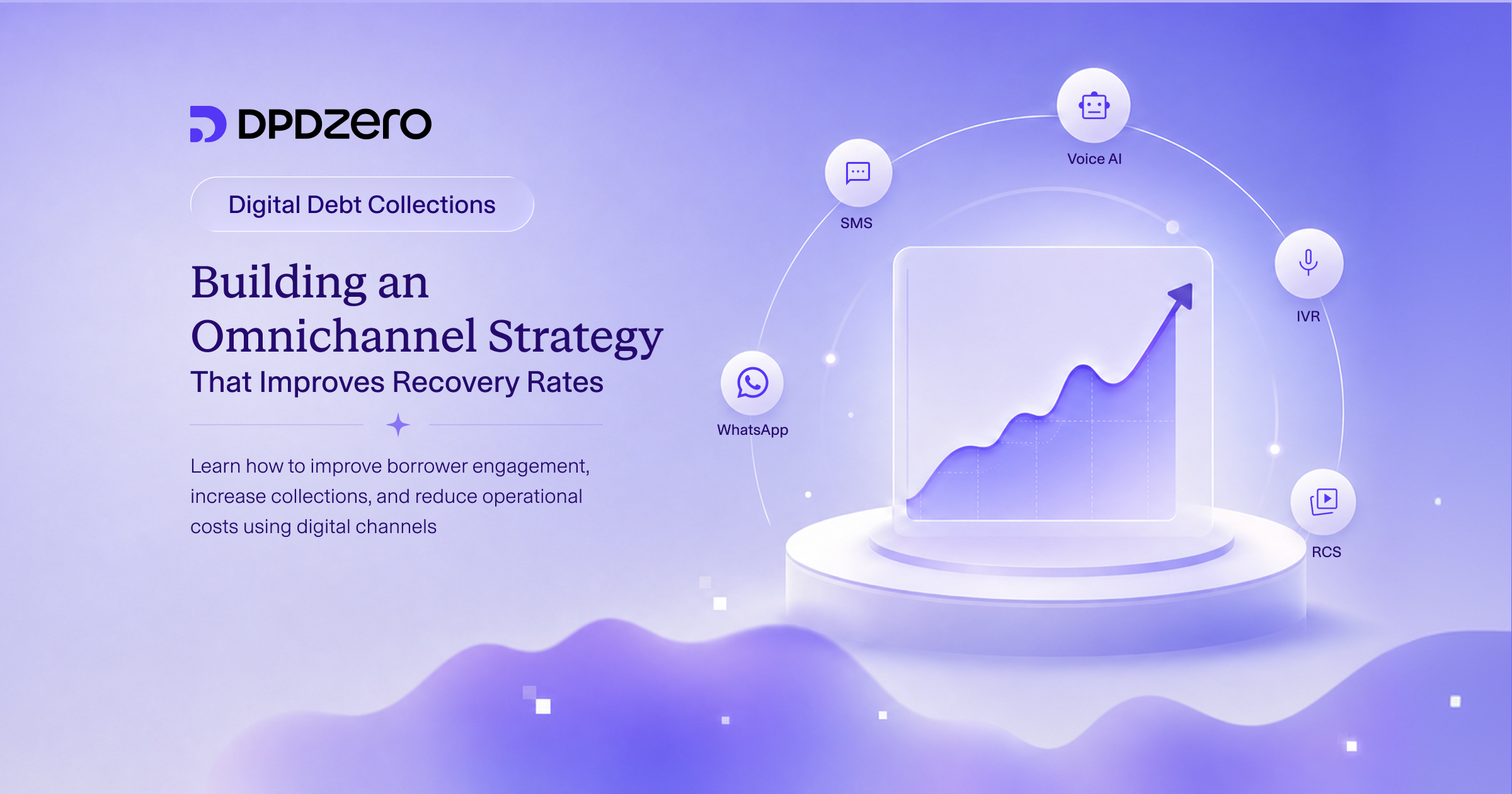
AI-Led Digital Collections runs this from Day 0. Digital picks the channel, timing and message for each borrower, so a festive cohort of lakhs gets nudged without an agent dialling. Automation moves loan data from your data into DPDzero, so festive loans enter the flow the day they're disbursed. For how to build the channel mix, read our omnichannel strategy guide.
Segment the festive cohort before it segments itself
Every festive cohort splits fast. Some borrowers forgot. Some are short until salary day. A few never planned to pay. Treat them the same and you overspend on the first group and under-serve the third.
Insights turns repayment, engagement and contact signals into risk cohorts with a next best action for each. Tag festive loans as their own cohort from the day they're disbursed.
Reach every borrower in their own language
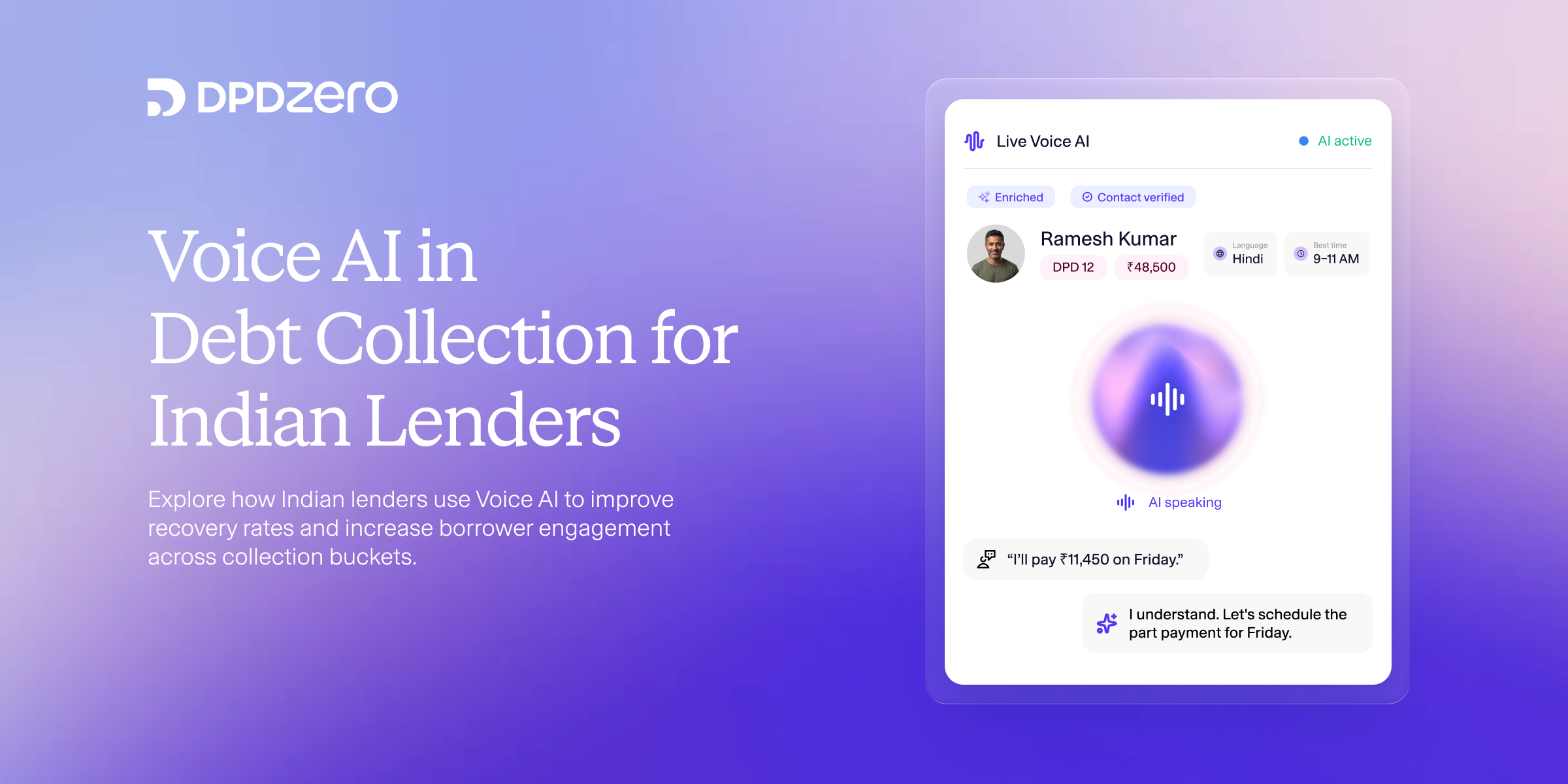
A borrower in Indore and a borrower in Coimbatore shouldn't get the same English call. Voice AI holds natural conversations in 8+ Indian languages and captures intent and promises to pay at festive-season scale. Here's how Voice AI works in Indian debt collection.
Put trained humans where judgment matters
Voice AI handles volume, along with nuances like a job loss, a hospital bill, or a dispute. TeleCalling puts DRA-certified advisors on those calls, guided by AI prompts and 40+ intelligence signals, across 20L+ outbound calls a day.
The two work as one collections arm. Voice AI resolves routine accounts and flags the ones that need a person. Advisors pick those up with the full conversation history in front of them.
Or hand over the outcome entirely
Some lenders don't want to run all of this in-house during their busiest quarter. Collections-as-a-Service runs collections end to end, and you pay for outcomes. If you're weighing partners, here's why Q4 is the best time to evaluate your collection partners.
Is Compliance + Tech Critical? The RBI Angle
Last festive season ran on rate cuts. This one starts with a hike.
On 7 October, the MPC raised the repo rate by 25 bps to 5.50% and moved its stance from neutral to calibrated tightening. It was the first hike since February 2023. Governor Sanjay Malhotra said future action can only be a hike or a pause, and the next MPC meeting runs from 2 to 4 December (RBI Monetary Policy Statements).
Repo rate hike impact on borrowers
Floating-rate EMIs rise as loans reset, or tenures stretch. CPI inflation reached 4.8% in August, and the RBI now projects 5.2% for FY27, citing a weak monsoon, El Niño and energy prices (policy summary). Groceries, fuel and EMIs now compete for the same salary.
The repo rate hike impact on borrowers doesn't stop at home loans. A household paying more on its home loan has less room for a festive phone EMI. When budgets tighten, borrowers choose which EMI to pay first, and small unsecured ones usually lose.
More stress plus tighter rules means tech isn't optional anymore
More borrowers under pressure means more contact. The new rules mean every contact has to be timed, recorded and logged. Doing both by hand at festive scale doesn't hold up.
DPDzero is built compliance-first: DRA-certified advisors, TRAI-compliant calling, ISO/IEC 27001:2022-certified data security, and audit-ready records of every interaction. It's the difference between tech that shows results and AI that only sounds good.
RBI Loan Recovery Rules 2027: What Changes on 1 January
On 6 August 2026, the RBI issued nine parallel Amendment Directions covering commercial banks, small finance banks, RRBs, co-operative banks, NBFCs, HFCs and AIFIs. All of them take effect on 1 January 2027 (RBI press release). Here's what the RBI loan recovery rules 2027 change for collections teams.
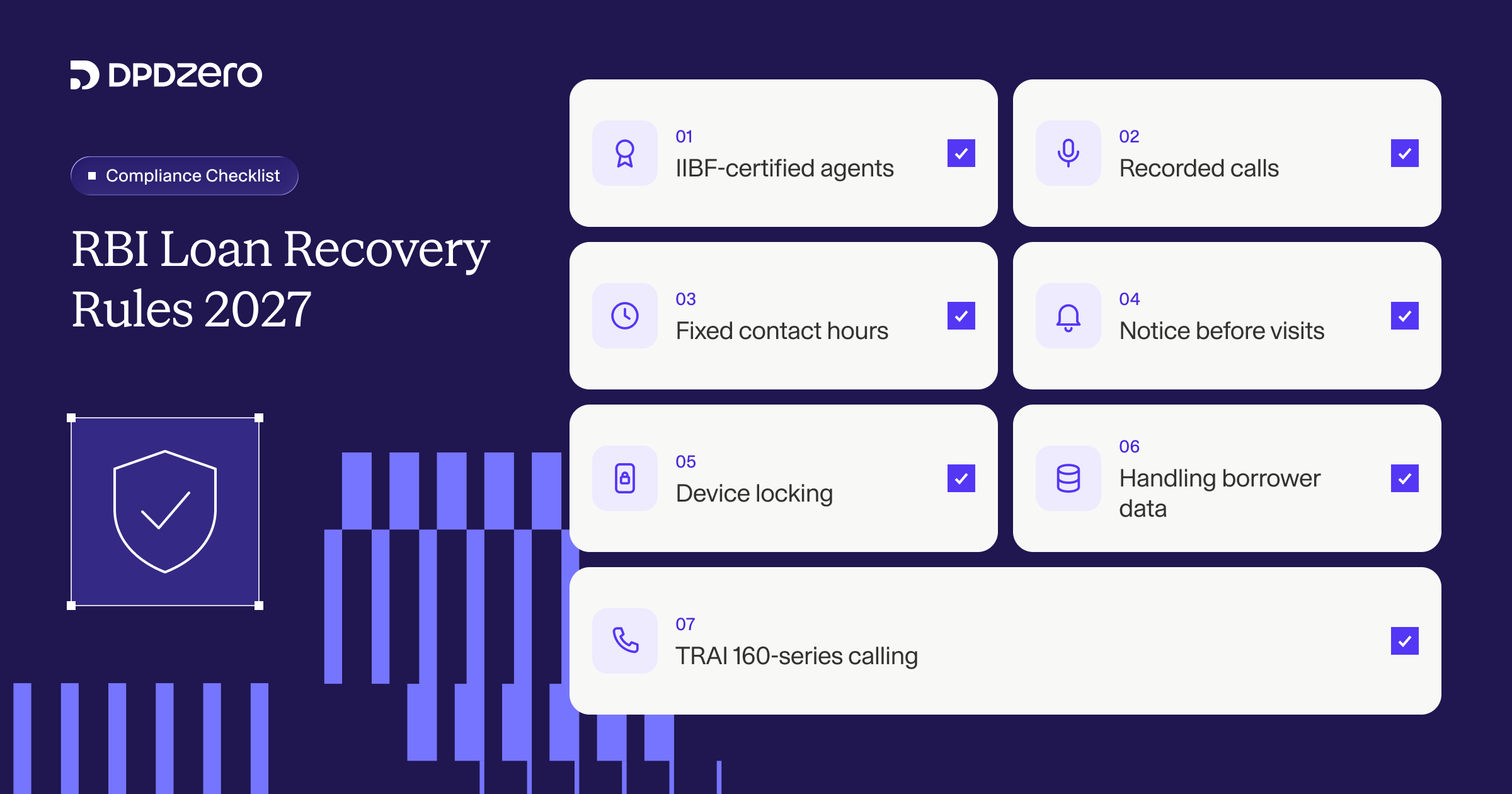
RBI's recovery directions: written policy and IIBF-certified agents
Every lender needs a board-approved policy on collection and recovery, covering its own staff and outsourced agents. Recovery agents must hold an IIBF certificate; agents already working without one get a year from the effective date to earn it (RBI's NBFC directions). Lenders must also verify agents' antecedents, publish their list of empanelled agencies, and make sure incentive targets don't push agents towards harsh tactics.
The big shift: the lender now owns the conduct of every agent working its book.
Recorded calls, fixed contact hours, notice before visits
Recovery calls must be recorded and the records kept for six months. Contact is allowed only between 8 am and 7 pm. Borrowers must get at least a day's notice before an agent's first in-person visit.
For a festive cohort of lakhs, every call now needs a timestamp, a recording, and a log you can pull up in an audit. And that’s a problem that your product needs to solve for, not something for the agents to look at.
Device locking: the 30/60 DPD rule
Lenders financing phones and other devices can't restrict a device before 30 days past due, and the full set of restrictions applies only after 60. Restrictions also have to step up gradually. For phones financed this festive season, these thresholds will be tested within weeks of the first missed EMI.
DPDP and borrower data
The DPDP Rules, notified in November 2025, phase in through May 2027, when the notice, consent and security obligations take full effect (AZB & Partners). Collections touches more borrower data than any other lending function. Here's our take on what the DPDP Act means for the lending industry.
TRAI calling rules and the 160-series
Service and transactional calls from RBI-regulated entities must come from the 1600 number series, with promotional calls kept on 140 (RBI circular). TRAI's migration deadlines for NBFCs ran out in February and March 2026, so this is already live. A collections call from a number the borrower doesn't recognise is a call that doesn't get answered.
Lend More, Recover More: Get Ready Before the First EMI
Origination teams had three months. Collections teams get the next thirty-six.
India has 690 million active loans, 5 crore more than last year. This festive season will add more, at higher rates and under stricter rules, with first EMIs landing in the same month the new rules begin. Festive season loan collections can't be a January scramble. They have to be ready before the first EMI is due.
Lenders preparing to lend more need a partner equipped to recover more.
Write to us at business@dpdzero.com or signup using the link below
Citations: Primary sources used
- CRIF High Mark, How India Lends — Credit Landscape in India, Q3 FY26
- CRIF High Mark, How India Lends, Q4 FY26 — accessed via secondary reporting
- TransUnion CIBIL, Credit Market Indicator, March 2026
- RBI Monetary Policy Committee, August 2026
- Paisabazaar festive borrower survey (10,200+ consumers), via Business Standard
FAQs
When do festive season loans start showing up as delinquent?
Usually 30 to 60 days after the first EMI. With Diwali on 8 November 2026, most of that lands in January and February 2027.
What are the RBI loan recovery rules 2027?
Nine RBI Amendment Directions issued on 6 August 2026 and effective 1 January 2027. They cover recovery policy, IIBF-certified agents, call recording, contact hours and device locking.
What is the repo rate hike's impact on borrowers?
Floating-rate EMIs rise or tenures lengthen as loans reset, which shrinks the budget left for every other EMI.
How can lenders improve post-festive season collections?
Start before the first EMI, segment the festive cohort, reach borrowers in their own language, put people where judgment matters, and keep every contact compliant.