


Imagine an allocation of two lakh accounts landing on the first of the month.
Your telecalling floor has 150 advisors. Each one makes 120 to 180 dials a day and connects on roughly a third of them. Work through the arithmetic, and establishing the first connect across that allocation takes roughly two weeks of time.
Result?
The accounts sitting at 5 DPD have moved to 20. Borrowers who needed a single reminder now need a negotiation. And the advisors who should have been closing settlements spent their first week discovering that half the numbers in the file simply don't answer.
The result is a familiar pattern:
- Delayed first contact across the portfolio
- Accounts rolling forward into deeper delinquency buckets
- Advisor time spent on discovery instead of resolution
- Rising cost per resolved case
The problem isn't effort. The problem is that calling capacity scales linearly with headcount, while portfolios don't.
This is where Voice AI changes the shape of collections. Not by replacing advisors, but by compressing the time between allocation and first contact from weeks into hours.
In this blog, we'll explore how AI voice for debt collection actually works inside an Indian lending workflow, how its role changes between early and late buckets, what RBI compliance demands from the calling infrastructure, and how lenders should evaluate it commercially.
So, let's start with what a Voice AI system actually does on a live collections book.
What Does an AI Voice Do in Debt Collection?
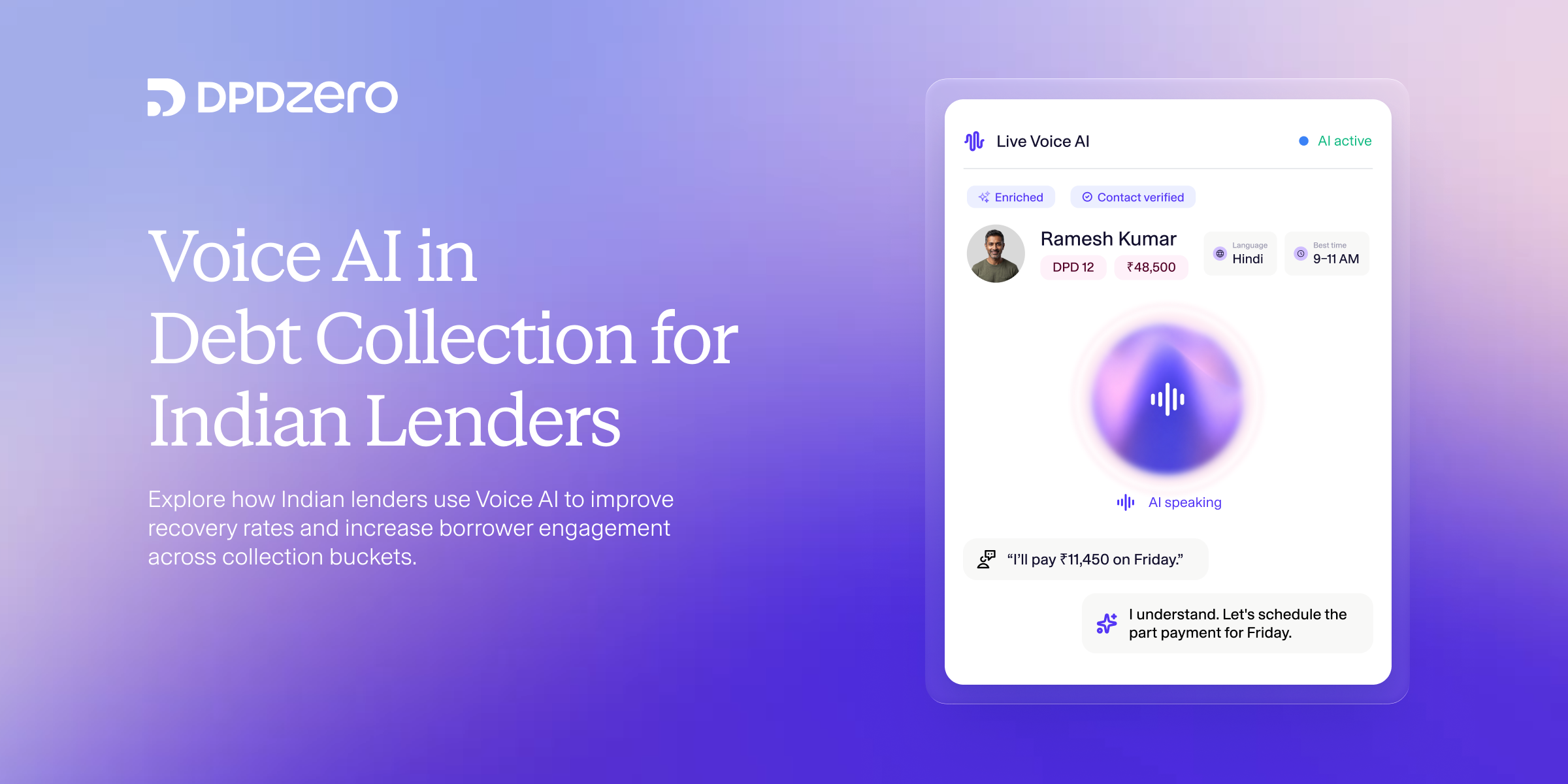
Voice AI in collections is an automated calling system that holds a genuine conversation with a borrower, understands the response, and takes an action based on it.
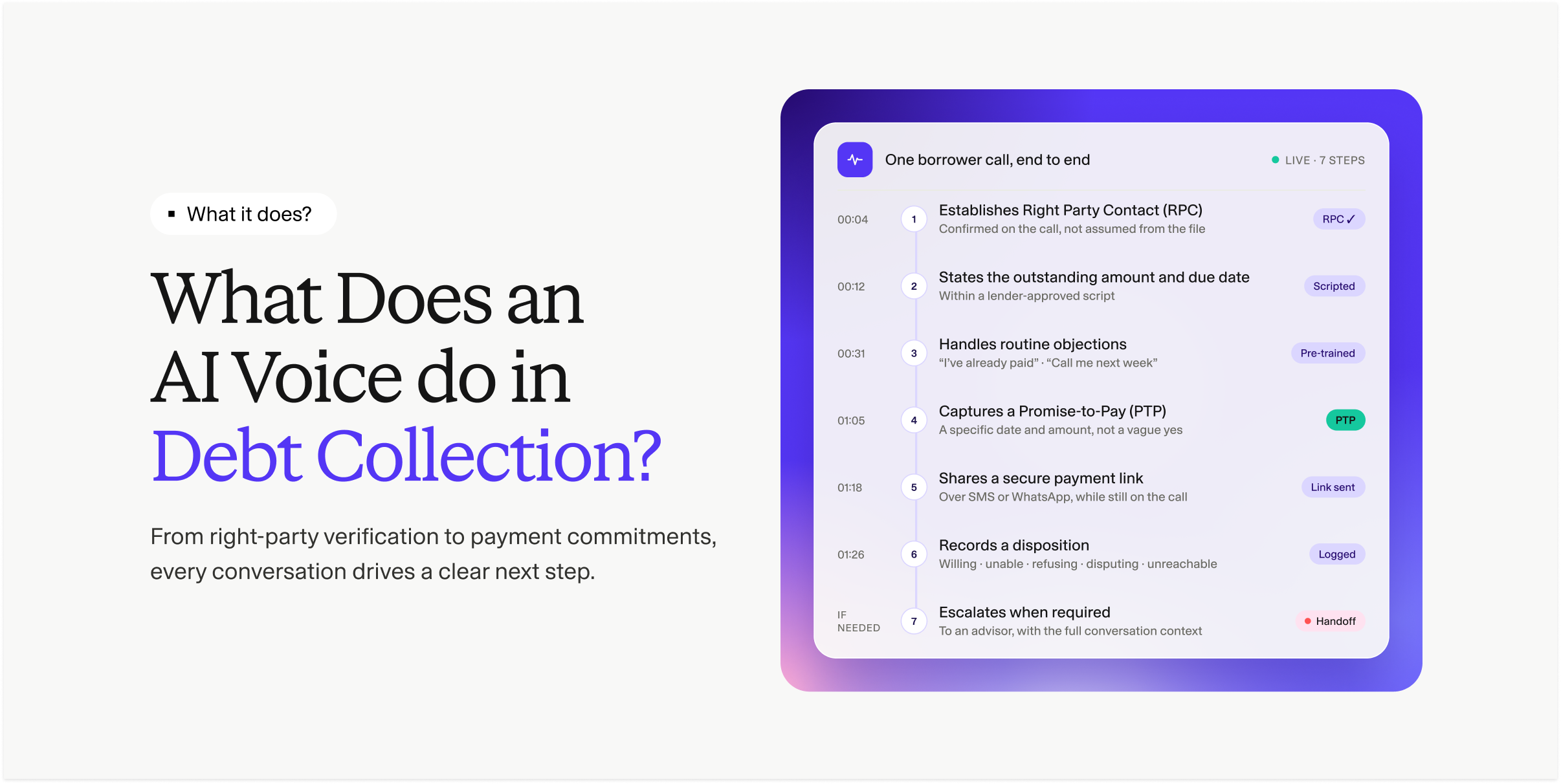
A single call typically performs some combination of the following:
- Establishes Right Party Contact (RPC) on the call rather than assuming it from the allocation file.
- States the outstanding amount and due date within a lender-approved script.
- Handles routine objections such as "I have already paid", "call me next week", or "I have lost my job", each through a pre-trained workflow.
- Captures a Promise-to-Pay (PTP) with a specific date and amount rather than a vague commitment.
- Shares a secure payment link over SMS or WhatsApp while the borrower is still on the call.
- Records a disposition classifying the borrower as willing, unable, refusing, disputing, or unreachable.
- Escalates when required, routing complex or sensitive conversations to a collection advisor with full conversational context.
What separates Voice AI from an IVR or a bulk voice blast is that final set of capabilities. An IVR reads out a menu. Voice AI listens, interprets intent, and adapts what it says next.
The second difference is concurrency. A telecalling floor grows only as fast as you can hire. Voice AI runs thousands of parallel conversations, which is why portfolio coverage maths changes so completely.
Why Telecollections Automation Is Not the Same as More Calling
Many lenders have already trialled some version of automated calling. Recorded voice blasts. Rigid IVR workflows. Dialers that connect a borrower to an advisor who has no idea who they are speaking to.
If those trials disappointed, the scepticism is well earned.
The useful distinction is between automating the dial and automating the conversation.
Automating the dial produces more attempts. It does nothing about the fact that most attempts generate no information. You still don't know whether the number is live, whether the borrower intends to repay, or which accounts genuinely deserve advisor time.
Automating the conversation produces a decision on every account. After a Voice AI sweep, the portfolio is no longer a flat list. It is sorted into borrowers who have already paid, borrowers who have committed to a date, borrowers who are unreachable, and borrowers who need a human conversation.
Outcome: Advisors begin the day from a qualified list rather than a raw allocation, and human effort stops being spent on discovery.
Voice AI for Early Bucket Collections: Preventing Roll-Forward Through Intelligent Conversations
The first few days after a payment becomes overdue often represent the highest opportunity for recovery. The challenge is reaching every borrower before accounts progress into deeper delinquency buckets.
Traditional calling operations simply cannot contact every allocated borrower within the required time window thereby resulting in lower coverage in initial days. DPDzero solves this challenge through its High-Velocity Outreach & Time Compression Workflows.
Within hours of allocation, Voice AI initiates outreach across the entire portfolio using thousands of concurrent AI-powered calls, ensuring borrowers are engaged while repayment intent is still high.
Voice AI for Early Bucket Collections:
- 100% coverage of BX accounts within hours of allocation
- 34% Promise-to-Pay (PTP) conversion in the pre-due bucket
- 40-60% reduction in cost per resolved case
Beyond rapid outreach, Voice AI automates complete first-level borrower engagement.
Moreover, a scalable first-level persuasion workflow manages routine borrower conversations by:
- Capturing Promise-to-Pay commitments.
- Handling common objections such as "I've already paid" or "Please call later."
- Executing intelligent retry strategies.
- Sending payment links instantly during conversations.
- Qualifying borrowers before human intervention.
Borrowers interact naturally through the Indic Language & Conversational Intelligence, which supports multiple Indian languages while dynamically adapting conversations based on borrower intent, repayment behaviour, and delinquency stage.
Every interaction is governed by DPDzero's Enterprise-Grade Infrastructure & Compliance Framework, combining RBI-compliant calling practices, intelligent retry policies, AI guardrails, and comprehensive audit trails to deliver secure, compliant, and scalable Automated Debt Collection Technology.
The outcome is simple: higher early-stage recoveries, lower operational costs, improved borrower experience, and reduced roll-forward into deeper delinquency buckets.
Voice AI for Late Bucket Collections: Turning Large Portfolios into Qualified Settlement Opportunities
Late-stage collections require a different objective.
Rather than reminding every borrower about overdue payments, lenders need to determine:
- Who is reachable?
- Who is willing to negotiate?
- Which borrowers should advisors prioritise?
DPDzero's Voice AI addresses this challenge through an AI-led portfolio sweep that identifies high-intent borrowers before human teams get involved.
Voice AI for Late Bucket Collections:
- Up to 8.5 lakh borrower accounts contacted every day
- 15% settlement conversion on Promise-to-Pay cases
The platform's Full-Base Coverage capabilities contacts the entire NPA portfolio using high-volume concurrent AI calling, exhausts available contact numbers, and maximises Right Party Contact (RPC).
Instead of asking collection advisors to manually identify interested borrowers, the AI-Led Lead Generation Layer analyses every conversation in real time to detect settlement intent, repayment willingness, refusal, inability to pay, and borrower reachability.
Only qualified, high-intent borrowers are then transferred to advisors through DPDzero's Seamless AI-to-Human Handoff, allowing collection teams to focus on negotiations and closures rather than repetitive discovery calls.
Together, Digital Channels and Voice AI create an intelligent Omnichannel Debt Collection ecosystem where every borrower interaction becomes more personalised, every communication channel becomes more effective, and every collection strategy continuously improves through data. This is what differentiates modern Automated Debt Collection platforms like DPDzero from traditional collections methodology.
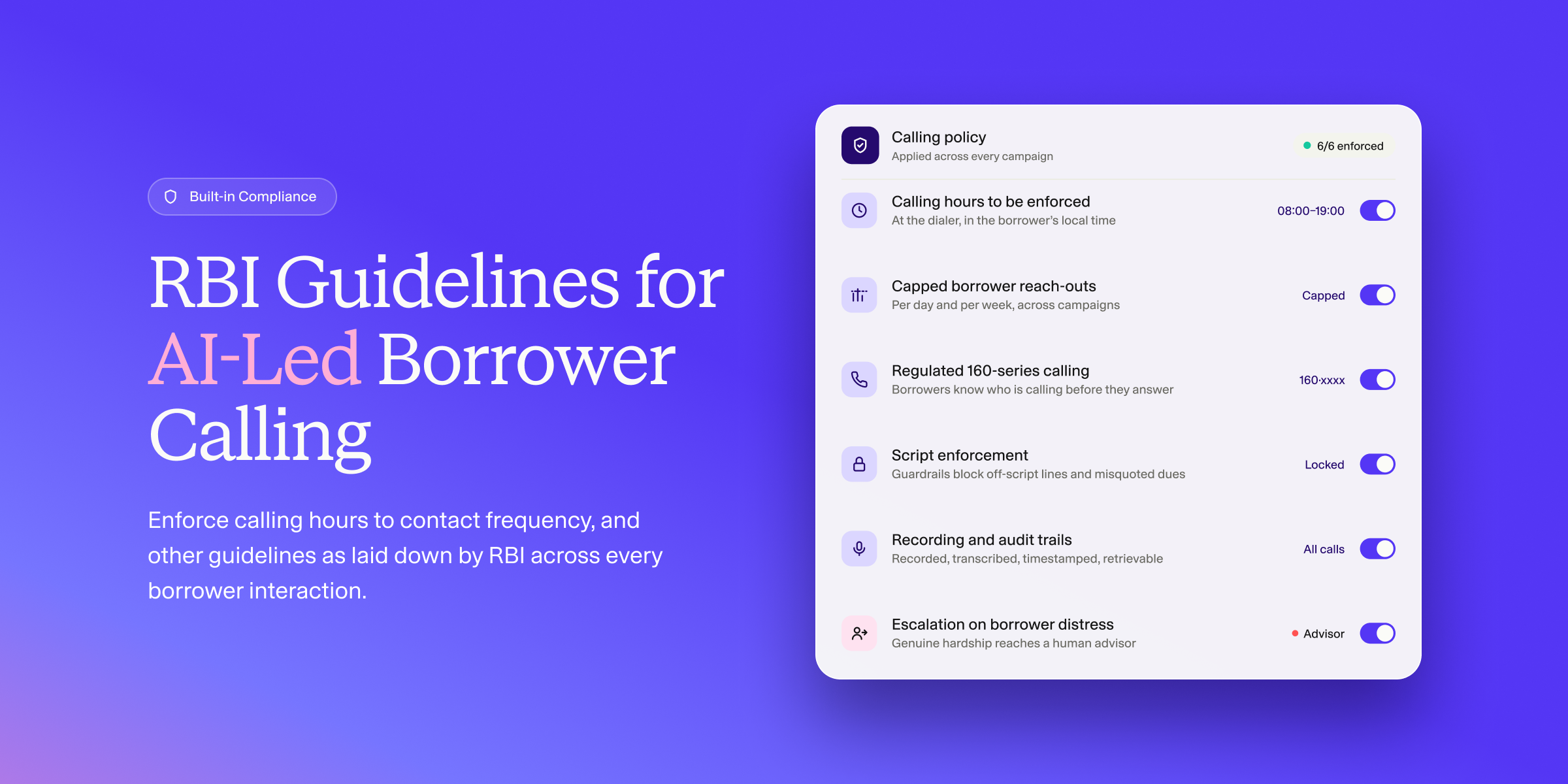
RBI Compliance Requirements for AI-Led Borrower Calling
Let’s discuss what determines the requirements a lender must follow before reaching out to borrowers to collect dues.
The requirements that do matter:
1. Calling windows: Recovery agent guidance restricts borrower contact to reasonable hours. This must be enforced at the dialer layer rather than left to a campaign setting, and it must respect the borrower's location rather than the server's.
2. Contact frequency: Repeated or poorly timed calls can quickly increase borrower complaints. Intelligent retry and throttling should cap attempts per borrower per day and per week, with the cap applied across every campaign.
3. Caller line identity: Outbound borrower calls should route through the RBI-compliant 160-series numbering series designated for regulated financial entities, so the borrower can identify the caller before answering. Calling from ordinary ten-digit mobile numbers creates a spam-flagging problem and a compliance problem simultaneously.
4. Script enforcement: The lender defines what the system may say. AI guardrails must prevent off-script statements, threats, or misstatement of the amount owed. A language model with a prompt and no hard constraints is not a controlled script.
5. Recording and audit trails: Every call needs to be recorded, transcribed, timestamped and retrievable whenever the need arises. When a grievance arrives a few weeks months later, you need the conversation itself, not a disposition code.
6. Escalation on borrower distress: A borrower in genuine hardship should reach a human advisor. This is partly regulatory and partly a matter of conduct, and it is worth testing explicitly during a pilot.
Impact: Compliance stops being a policy document and becomes something enforced at the infrastructure layer, which is the only place it holds at scale.
How to Evaluate the Economics: Cost per Resolved Case
Voice AI is usually priced per minute or per call. Neither is the right number to evaluate on.
Cost per call always flatters automation. The number that determines whether this is worth doing is cost per resolved case, because it accounts for the calls that produced nothing.
Work it the way your finance team will:
- Total channel cost across a cycle, including platform fees, telephony and integration effort
- Divided by cases actually resolved through that channel, where resolved means paid or a PTP that converted, not merely contacted
Then compare that against the fully loaded cost of a telecalling seat working the same cohort, and against agency commission on the same accounts.
Across DPDzero deployments, AI-led outreach has delivered a 40 to 60% reduction in cost per resolved case. But the more important question for a collections head is where that saving originates. It does not come from cheaper conversations. It comes from advisors no longer spending time on accounts that were never going to convert, and from agency allocation narrowing to the cases that genuinely require it.
Two leading indicators worth tracking through a pilot, because they move before recovery numbers do:
- Coverage at 24 hours: what percentage of the allocation received a genuine conversation attempt on day one
- Disposition quality: what percentage of calls produced a usable classification rather than an unknown
If coverage is high and dispositions are clean, recovery follows. If coverage is high and dispositions are noisy, the system is talking without listening.
A Checklist for Evaluating Voice AI Vendors
Twelve questions that separate a working system from a well-rehearsed demo:
- What is your concurrency ceiling, and what happens to conversation quality at that ceiling?
- Which Indic languages, and can the system switch mid-conversation without restarting?
- How does it handle Hinglish and code-mixing?
- Are outbound calls routed over 160-series infrastructure?
- How are calling windows and retry caps enforced, and at which layer?
- What physically prevents an off-script statement?
- What triggers escalation to an advisor, and what context transfers with it?
- How is a PTP captured, and what happens between the promise and the payment?
- What does the disposition taxonomy look like, and how does it write back to our LMS or CRM?
- What is the integration effort in weeks, and what is required from our technology team?
- What is your cost per resolved case on a portfolio like ours, demonstrated from a live deployment?
- Which Indian lenders are running you in production today, and can we speak with one?
Why DPDzero's Voice AI Fits the Next Phase of Your Collections
Every question in that checklist was written from the same place: what actually breaks when AI-led calling meets a live Indian lending book. Here is how DPDzero's Voice AI answers them.
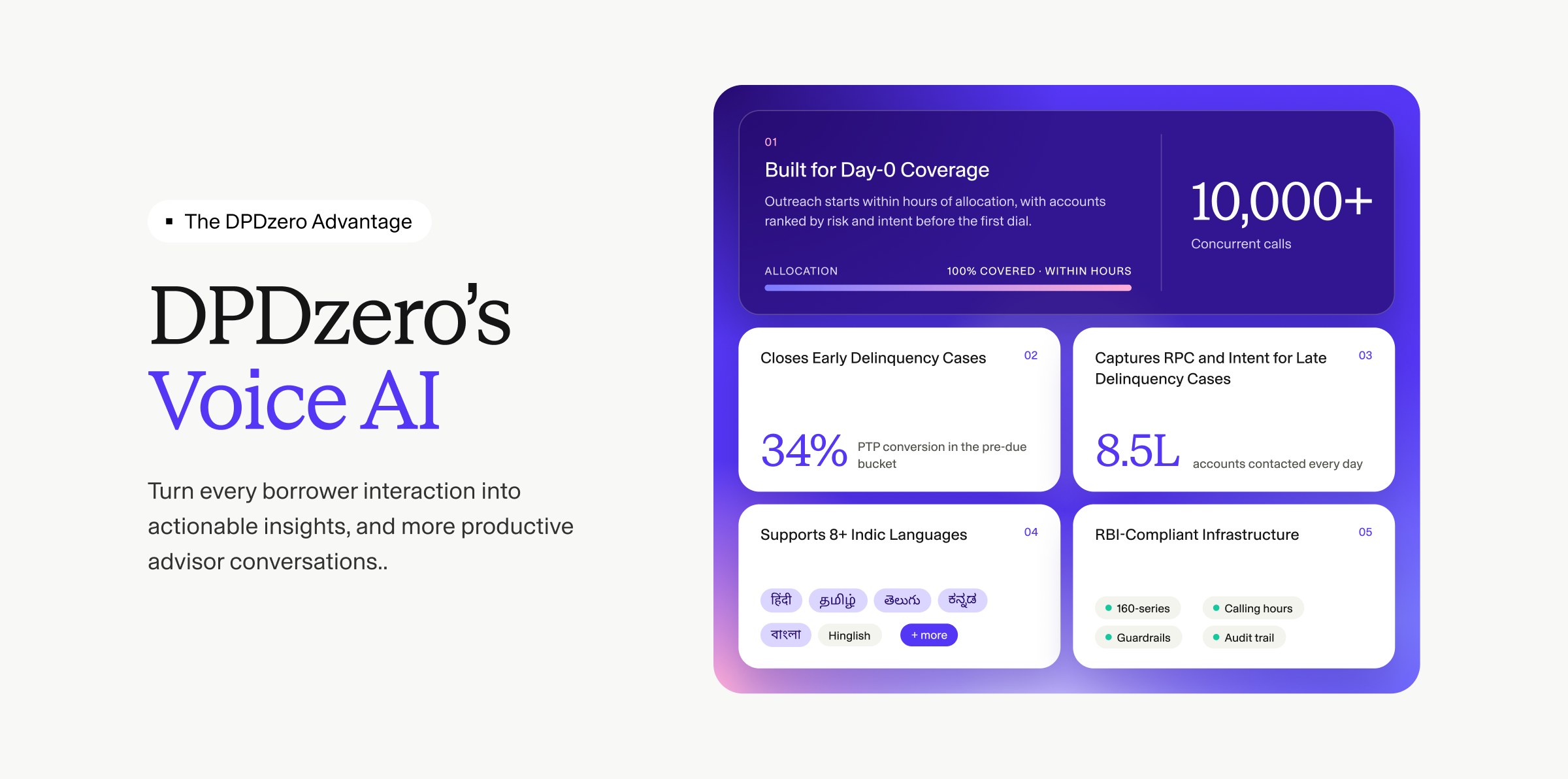
Built for Day-0 Coverage
Most systems improve the rate at which you work through an allocation. DPDzero's Time Compression capabilities remove the queue altogether.
- Day-0 Activation: Borrower outreach begins within hours of allocation from the lender.
- Mass Parallel Dialing: 10,000+ concurrent calls, with up to 8.5 lakh accounts contacted daily through AI-led outreach.
- Auto Call Prioritisation: Accounts are ranked by risk, intent signals and likelihood of conversion before the first call is placed.
Outcome: 100% of allocated accounts covered within hours, so intent is captured before accounts roll into deeper buckets.
Conversations That Close, Not Just Connect
Reaching a borrower is the easy half. DPDzero's first-level persuasion layer is built to complete the interaction without advisor involvement.
- Automated PTP Capture with date and amount, triggering an instant payment link on the call.
- Objection Handling Framework covering the responses collections teams hear every day, through pre-trained workflows.
- Multi-Attempt Retry Logic across time windows, with capped outreach intensity per borrower.
- First-Connect Resolution Layer that filters paid, PTP-tagged and responsive borrowers before anything reaches an advisor.
Outcome: Early-stage conversions rise while advisor dependency falls.
Genuine Indic Language Depth
Full Indic Language supports dynamic switching mid-conversation, along with Hinglish for digital-native borrowers. A Real-Time Conversation Orchestrator manages tone and pacing across every concurrent call, while Persona and Tone Modules adapt conversation style to borrower segment, delinquency stage and risk profile.
Outcome: Consistent, localised conversations across every geography in the portfolio.
Compliance Enforced in the Infrastructure
- RBI-Compliant Calling Framework with outreach confined to defined time windows and calls routed via 160-series infrastructure.
- Intelligent Retry and Throttling to prevent borrower fatigue.
- AI Guardrails and Script Enforcement binding every conversation to lender-defined policy.
- End-to-End Call Logging and Audit Trails, with every interaction recorded, transcribed and stored.
Outcome: Compliance that is provable rather than promised, with zero borrower escalations.
An Intelligence Layer
DPDzero segments portfolios into risk cohorts and routes Voice AI to the segments where it is the most cost-efficient channel. Strong PTPs and resolved cases are filtered out. Non-responsive and complex accounts escalate to telecalling with full borrower context and disposition attached, which is what lifts conversion on the human side of the handoff.
Outcome: Advisors spend their day on negotiation and closure rather than discovery.
What's Next for Lenders
If your allocation takes more than a few days to work through its first pass, you are losing recoveries to elapsed time rather than to borrower unwillingness. That is a capacity constraint, and automated conversation is the one thing that genuinely resolves it.
Judge any Voice AI for NBFC collections deployment on four questions:
- Does it reach the entire book within hours of allocation?
- Does it hold a real conversation in the language the borrower actually speaks?
- Does it enforce compliance at the infrastructure layer rather than in a policy document?
- Does it lower cost per resolved case, not merely cost per call?
DPDzero's Voice AI operates as the conversational layer within a full stack collections platform spanning Digital, Voice AI, Telecalling and Field operations, and runs today on collections books for HDFC, IndusInd, Manappuram, Tata Capital, L&T Finance and Money View.
For a quick portfolio review with DPDzero experts, please book a demo with us by clicking below.
Frequently Asked Questions (FAQs)
1. What is Voice AI?
Voice AI is an artificial intelligence system that conducts spoken conversations with borrowers over a phone call, understands what they say in response, and acts on it in real time. In debt collection, it establishes Right Party Contact, communicates the outstanding amount, handles routine objections, captures Promise-to-Pay commitments, shares payment links, and records a disposition for every call.
2. Will an AI voice bot replace our telecalling team?
It changes what they do. Volume work such as establishing reachability and capturing straightforward commitments moves to Voice AI, while advisors move to negotiation, settlement and complex cases. Most lenders redeploy rather than reduce, because the constraint was never a shortage of accounts to work.
3. Is AI-led calling permitted under RBI's recovery agent guidelines?
Automated outreach is not prohibited, but the same conduct requirements apply as they would to a human agent, including permitted calling hours, no harassment, accurate representation of the debt, and a clear route to a person. The obligation sits with the lender regardless of who or what places the call. Any specific deployment should be reviewed by your compliance team against current circulars.
4. How quickly can Voice AI go live?
Integration with the loan management system and payment stack is usually the longer pole, not the AI itself. Plan in weeks rather than months, and expect the first fortnight of a pilot to be spent tuning scripts against real call recordings.
5. What happens when a borrower realises they are speaking to AI?
Most realise quickly, and at the early bucket stage it matters less than lenders expect. Complaints are rarely caused by the AI itself. They are caused by being called at the wrong hour, too frequently, or about the wrong amount. Get those right and borrower escalations stay near zero.
6. Does Voice AI work for borrowers who are not digitally active?
Voice is the channel that reaches them. A borrower who ignores SMS and has never opened the app will still answer a phone call, which is why voice remains the highest-coverage channel in Indian collections.
7. Can Voice AI be used for both early and late bucket collections?
Yes, though the objective differs. In early buckets the goal is PTP capture and preventing roll-forward. In late buckets it is full-portfolio sweep, reachability and settlement intent detection, generating qualified leads for advisors to close.